You send an opening message and get a warm reply, and then you run out of things to say. It happens to plenty of people, and it rarely has anything to do with how interesting you are.
If you're not sure how to keep a conversation going online, the causes are usually small ones: a closed question, a reply with nothing to pick up, or a mismatch in pace. Your texting style plays a part, too, because readers take a lot from reply speed and length. Most of these have a quick fix.
Why Conversations Stall Online
Spoken words come with a voice and a face, but a written message has neither, so the reader fills in the tone from their own mood. That fill-in is often wrong.
A 2025 study in Acta Psychologica tested this. Researchers asked 46 participants to write messages expressing 22 emotions without naming them, and senders often overestimated how well the emotion would come across.
Missing tone is only one reason a conversation fades. A few others come up often:
-
Closed questions that end in a yes or no.
-
Replies that answer the question but give the other person nothing new to pick up (a polite "yes, it was great" is the classic case).
-
Mismatched pace, such as one person sending paragraphs while the other sends a single word.
Start With Questions That Invite a Story
A closed question can be answered in one word, and then the conversation often stalls right there. An open question asks for a story or a reason, and conversation starters like these give the other person room to say more.
Small rewrites turn a closed question into an open one:
|
Closed question |
Open version |
|
Do you like hiking? |
What's a trail you'd happily walk again? |
|
Did you have a good weekend? |
What did you get up to this weekend? |
|
Do you cook? |
What's a dish you make when you want comfort food? |
|
Are you busy at work? |
What's taking up most of your week? |
On Miaromance, two tools can help with that first message. Icebreakers are ready-made opening lines that you can send to several members at once, which is a quick way to start a few conversations. Inside each chat there are also ready-made lines you can edit and save as your own template, and those work well once you've tied them to something on the other person's profile.
Questions to Ask When You Run Out of Things to Say
Hitting a blank is normal. Treat these icebreaker questions as a starting point and put them in your own words.
When you're writing to someone new, pick one detail from their profile and ask about it. For example:
-
"I saw you play guitar. What's the first song you learned?"
-
"How'd you get into photography?"
-
"What's your favorite place to read?"
If replies are getting short, skip the general check-in. Ask about one specific moment instead:
-
"What's the last show you couldn't stop watching?"
-
"What's something small that made your week better?"
To go a little deeper, keep it light and curious. Skip anything that feels too personal for where the chat is:
-
"What did you want to be when you were ten?"
-
"What are you looking forward to this month?"
-
"What's a hobby you picked up by accident?"
Reply to What They Said, Then Add Something
Listening in text looks different from listening in person, because you can't nod. You show it in the reply. If you're wondering how to be a good listener in writing, start with the details the other person gave you.
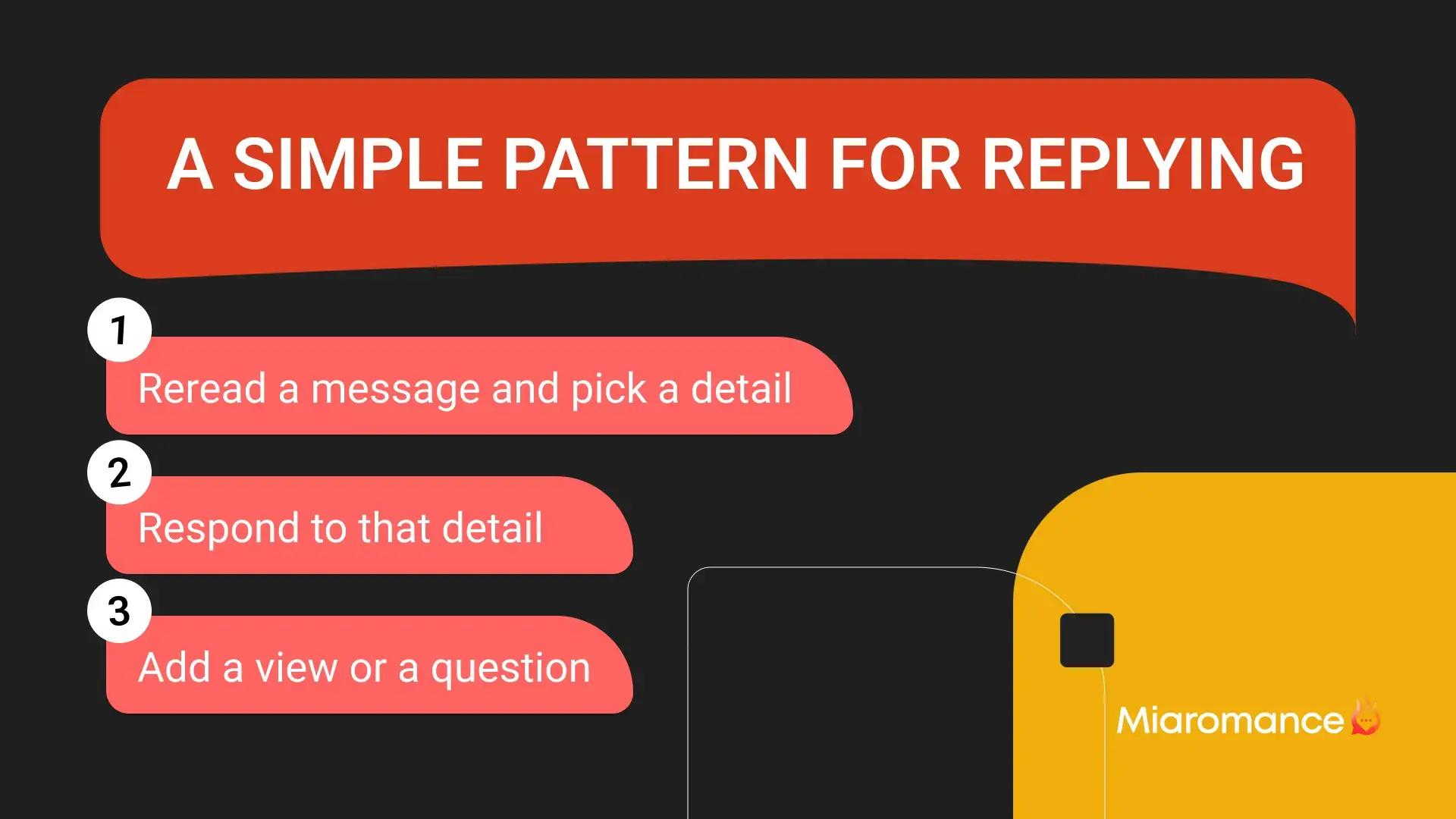
A simple pattern works for most replies:
-
Reread their message once and pick one detail that stands out.
-
Respond to that detail in a sentence.
-
Add your own view or a question (one is plenty).
Most replies go wrong at the first step. A reply that jumps straight to your own story reads like a change of subject.
If part of a message is unclear, ask. "Do you mean the second option?" beats guessing wrong.
Share a Little, Ask a Little, Then Change the Topic Smoothly
A good exchange works a bit like a shared notebook, where each person adds a line and neither one fills the whole page. Three questions in a row start to feel like a survey.
Once you've responded to what they said, add a sentence of your own on the same topic. For example: "I finally finished a series I'd been putting off for a year. Do you have one you rewatch?" That gives the other person something to react to and something to answer.
When a topic winds down, build a bridge instead of jumping. Pick a word from their last message and link it to something new, like "You mentioned the road trip. Do you have a go-to playlist for long drives?"
Reading Reply Speed, Length, and Tone Without Over-Reading
Your texting style is the sum of small habits, such as how fast you reply and how much you write. Readers notice them, and they sometimes read more into a habit than you meant. The same goes in reverse.
Here are common patterns and other ways to read them:
|
What you may see |
Other readings worth considering |
|
A reply within minutes |
An open evening, or a habit of answering right away |
|
A reply after several hours |
A busy day, a different time zone, or a message they wanted to answer properly |
|
A one-word reply |
Habit, or a message typed in a hurry |
|
A very long reply |
Someone who enjoys writing, or a topic they care about |
Punctuation works as a tone of voice. An exclamation point can sound warm, while a period after a short reply can sound final, though some people use periods out of habit. No one has ever been reassured by a lone "k."
To keep the exchange balanced, aim for a length similar to theirs and add one detail or question. If your own pace is slow, a short note such as "Busy day, I'll write properly tonight" removes the guesswork.
When a Second Message Helps and When It Pushes
Double texting means sending a second message before the other person has answered the first. It has a reputation as a mistake, but context decides.
A second message often helps when it adds something useful:
-
A detail the first message left out, such as a time or a link.
-
A correction, like a typo that changed the meaning.
-
A light, new thought after a day or so has passed (with no pressure attached).
It often pushes when it only adds weight to the first message:
-
A restatement of what you already said.
-
A "did you see my message?" sent within hours, or several follow-ups in a row, which can feel like a countdown.
Before you send a follow-up, ask whether it gives the other person something new to respond to. If it does, send it. If it only repeats the first message, give that one more time.
How to Keep a Conversation Going When Replies Slow Down
Pauses are normal. People get busy or tired, and a quiet day rarely means the conversation is over. Letting a thread rest can help it feel relaxed.
When you'd like to pick a thread back up, a few options work well:
-
Return to something they mentioned earlier, such as "How did the trip planning go?"
-
Pass along something that connects to an earlier topic, like an article or a song.
-
Ask a fresh question about a different topic if the first one has run its course.
If you'd rather leave things open, try a line like "No rush, I'm around whenever you want to pick this up." It lets the other person reply on their own schedule. Some conversations fade anyway, and that's fine.
Putting These Habits Into Your Next Conversation
When you're still working out how to keep a conversation going online, start with one habit from this list, such as an open question or a reply that picks up a detail from their last message. Your texting style can stay your own.
If you'd like to practice, head to Miaromance and read the facts to know before joining. They cover common questions one at a time.